
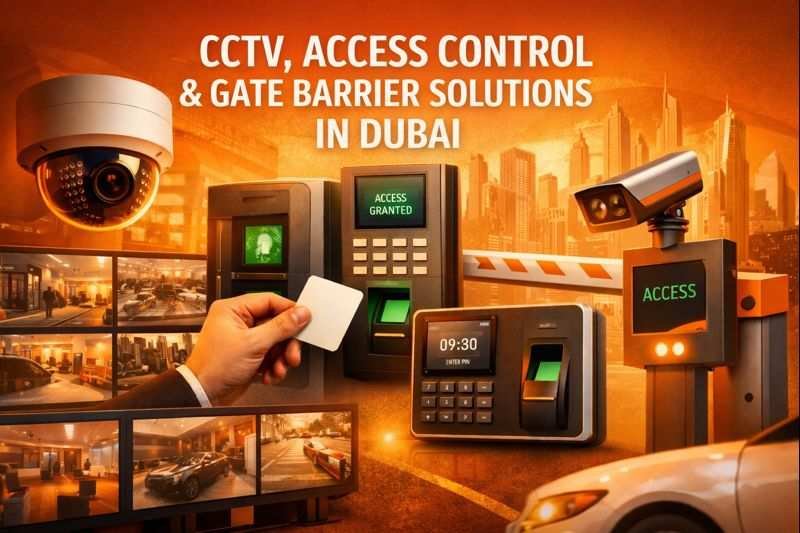
Every day, thousands of vehicles enter and leave car parks, residential communities, office buildings, and industrial sites. Without proper control, that traffic quickly turns into a security risk and an operational headache. That’s where gate barrier systems come in.
In this guide, we’ll explain how gate barriers work, the different types available, the access control options you can integrate, and what to consider before you invest. We’ll also show how Tecqx helps businesses choose, install, and maintain the right system.
What Is a Gate Barrier System?
A gate barrier (also called a boom barrier) is a motorised arm that raises and lowers to allow or block vehicle access. It’s typically paired with an access control method, such as a remote, RFID card, ticket, or number plate recognition, so that only authorised vehicles can pass.
A complete system usually includes:
- Barrier cabinet with motor and control unit
- Boom arm (straight, folding, or articulated)
- Safety devices such as loop detectors and photocells
- Access control readers or cameras
- Optional integration with parking management or CCTV software
Benefits of Installing a Gate Barrier
- Improved security: Stop unauthorised vehicles from entering your premises
- Traffic control: Organise vehicle flow at entrances and exits
- Parking management: Track occupancy, issue tickets, and collect fees
- Audit trail: Log every entry and exit for reports and investigations
- Reduced manpower: Automate gate operations and cut guard workload
- Professional image: A smooth, modern entry experience for tenants and visitors
Types of Gate Barriers
1. Standard Boom Barriers
The most common choice for car parks and office buildings. Available in different arm lengths to suit lane widths.
2. High-Speed Barriers
Open and close in around a second or less. Ideal for busy parking entrances, malls, and toll points where queues must be avoided.
3. Folding Arm Barriers
Arms that fold as they rise. Perfect for basements and areas with low ceiling height.
4. Fence or Skirt Barriers
Include a lower grille or skirt to block pedestrians and motorbikes from passing underneath.
5. Heavy-Duty and Long-Span Barriers
Built for industrial sites, ports, warehouses, and wide lanes with heavy vehicles.
6. Anti-Terror / Crash-Rated Barriers
Combined with road blockers or bollards for high-security sites such as government buildings and critical infrastructure.
Access Control Options for Gate Barriers
| Access Method | Best For | How It Works |
| Remote control | Small sites, villas | Users press a button on a handheld remote |
| RFID card / tag | Offices, communities | Users tap a card or carry a windscreen tag |
| UHF long-range reader | Residential communities, staff parking | Reads a windshield tag from several metres away, no stopping required |
| ANPR (number plate recognition) | Malls, hotels, smart buildings | Camera reads the plate and opens for authorised vehicles |
| Ticket dispenser / pay station | Paid public parking | Visitors take a ticket and pay on exit |
| Intercom / mobile app | Visitor management | Guests call security or are granted access digitally |
Key Factors to Consider Before Buying
1. Traffic volume: How many vehicles pass per hour? High traffic needs high-speed, high-duty-cycle motors.
2. Lane width: Determines the arm length and barrier model.
3. Site conditions: Outdoor barriers in the UAE must withstand heat, dust, and humidity.
4. Ceiling height: Basements may need folding arms.
5. Safety: Loop detectors and photocells prevent the arm from closing on vehicles or people.
6. Integration: Should it connect with CCTV, parking software, or your access control platform?
7. Power backup: Consider UPS or manual release for power outages.
8. Maintenance: Moving parts need regular servicing to stay reliable.
Gate Barrier Maintenance: Why It Matters
Barriers operate thousands of cycles every month. Without maintenance you may face motor failures, misaligned arms, faulty sensors, and, worst of all, safety incidents. A preventive maintenance plan should include:
- Checking motor and gearbox performance
- Inspecting and balancing springs
- Testing loop detectors and photocells
- Cleaning and lubricating moving parts
- Checking readers, cameras, and software integration
Why Choose Tecqx for Gate Barrier Systems?
Tecqx delivers complete vehicle access control solutions, from consultation to after-sales support.
- Site survey and consultation to recommend the right barrier and access method
- Supply of reliable, proven barrier brands built for the regional climate
- Professional installation including civil work coordination, loops, and cabling
- Integration with CCTV, ANPR, RFID, UHF, and parking management systems
- Annual maintenance contracts with fast response times
- Repairs and upgrades for existing barriers, including replacing old access readers
Frequently Asked Questions
How long does it take to install a gate barrier?
A standard installation can often be completed within one to two days, depending on civil work, cabling, and integration requirements.
Can a gate barrier work during a power cut?
Yes. Many models support UPS backup or have a manual release so the arm can be raised during an outage.
Is ANPR better than RFID?
It depends. ANPR needs no cards or tags and is great for visitors, while RFID/UHF is very reliable for known users. Many sites use both.
Can you integrate a barrier with my existing CCTV?
In most cases, yes. Tecqx can link barrier events with your CCTV for complete visual records of every entry and exit.
How often should a boom barrier be serviced?
Typically every three to six months, depending on traffic volume and environment.
Secure Your Entrances With Tecqx
Whether you manage a residential community, office tower, mall, or warehouse, Tecqx can design and install a gate barrier system that keeps traffic moving and your property secure.
Filed under: Uncategorized